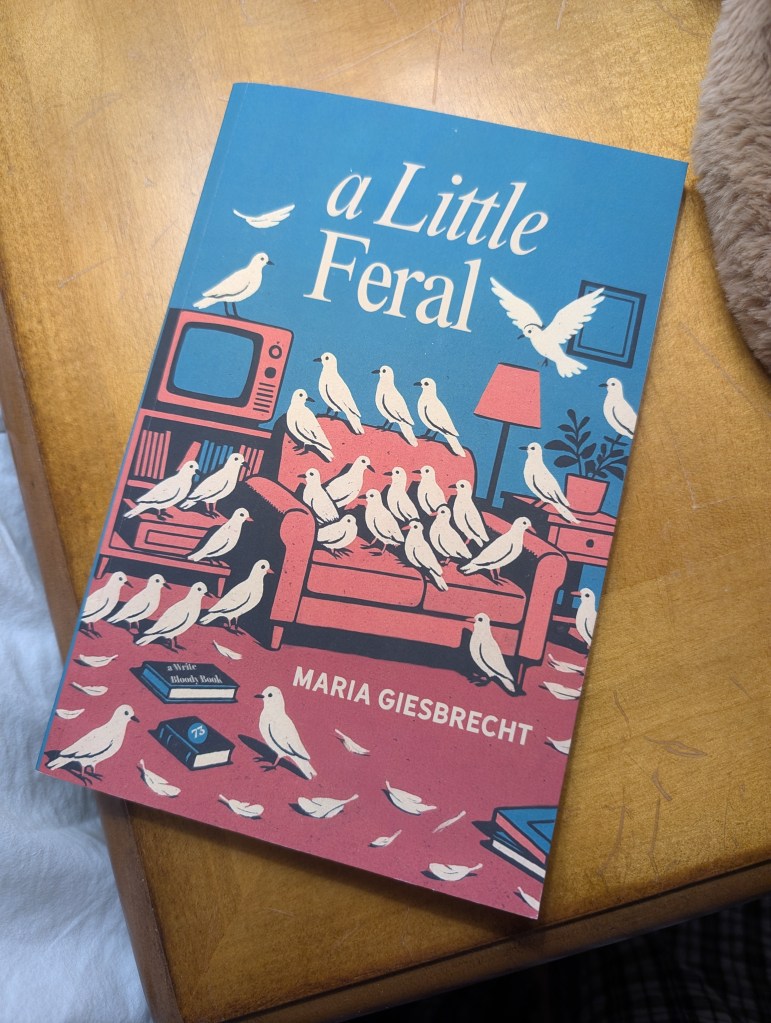
I first ran across Maria Giesenbrecht’s poetry on Instagram (@theguelphpoet). I found her poems crisp and innovative; I reveled in their imagery and honesty. When Giesbrecht issued a challenge for National Poetry Writing Month (NaPoWriMo), I eagerly responded to her prompts, which were also part of a contest in which the winners would be published in Campfire Poets Anthology. One of my poems ended up being included in the third installment! I was thrilled that my work was noticed and seemed fitting among the other beautiful poems included.
When I heard about the impending publication of A Little Feral, I knew I would have to pick up a copy, and I was not disappointed. This book is holy, honoring the full spectrum of being alive while human. I know that’s a broad assessment, but these poems don’t suffer from any epic arrogance or generalities. They are rooted in the particular to convey the universal–what I tell my students is the essence of any good art in any genre. The speaker in these poems disarms readers while enthralling them: we are both a bit in love and a bit uncomfortable as she chronicles a life and a world brimming with both pain and beauty. We know from the first (and titular) poem that the journey with her will be a bit unhinged. The image of vomiting stars heralds Giesbrecht’s capacity to merge the sublime with the base; indeed, the cosmology of these poems is rooted in the body. Similarly, in poems redolent of Dickinson, we find a faith rooted in doubt: the speaker is haunted by a God/god she didn’t know was real until she left him behind to search for sustenance the vast feast of existence: in men, in music, in travel, in landscapes both outer and inner. In one poem, the speaker playfully calls out religion that consigns God to the stratosphere: “You think there is space between/ the two of you” but God dwells in every woman (“Don’t Take This the Wrong Way, But God Can’t Hear You”). She celebrates this intimacy while nevertheless admitting, “There is no pretty way to save yourself” (“You Might Have to Run for a Hundred Miles in the Desert”) and declaring, “To be born/ again is to give birth to yourself alone” (“Church Pregnancy”). For Giesbrecht, the self and the universe are nesting dolls, always birthing one another, but redemption is found in this continual process rather than in any decree from a distant, divine authority.
This collection emerges from the poet’s background, wrestling with her father’s alcoholism and abuse as well as the high control religion that shielded him from accountability. It will resonate with anyone who has deconstructed their faith or faced family trauma. But there is no self-pity here, no ham-fisted rants: rather, more an acknowledgment that what we come from (and out of) may be troubling and follow us into the world we create for ourselves, but those echoes can shape us without defining us forever. This is what it means, perhaps, to be “a little feral”–we stray from the places and people who raised us without ever totally leaving them behind.
What shines most brightly for me in this collection is the speaker’s playful sincerity. She rejects certainty in order to embrace curiosity; these poems delight in their freefall through Keats’ negative capability. Simultaneously, they sustain an emotional stamina that allows the speaker to keep interrogating herself and her world. She takes this mission seriously, acknowledging that “To have a heart/ is to have a task” (“This Is All I Know about Having a Heart”). This poet has taken on her heart’s task with a wisdom and humor that deserve our attention.

